
KILLER REALM JOURNAL · GUIDES · 2026-11-24
Egyptian Domino tactics: keep options open and understand a blocked round
Plan around the two open ends, weigh heavy tiles against flexibility, and understand how AalAhwa scores a blocked Egyptian Domino round.
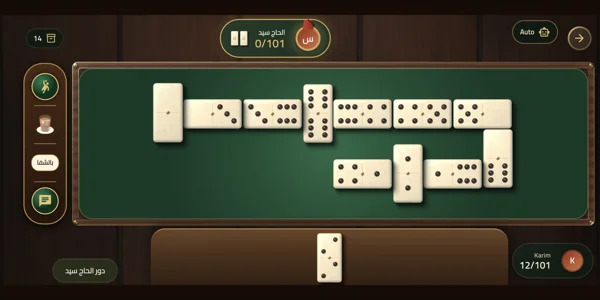
By Killer Realm Game Lab · Checked against AalAhwa’s Egyptian Domino rules on 24 November 2026. This is a focused tactics guide, rather than a repeat of our beginner’s tour. Examples are teaching positions, not claims about a recorded match.
Read the two ends before choosing a tile
In Egyptian Domino, your useful information is the two open numbers, the tiles in your own hand and the tiles already played. A tile that matches an end is legal, but the end you leave matters as much as the tile you remove. Before playing, ask: which numbers will be exposed afterward, and how many of my remaining tiles can use them?
Suppose the ends are 2 and 5. You can play 2–6 on the 2 end, leaving 6 and 5, or 5–3 on the 5 end, leaving 2 and 3. If your remaining hand contains several threes and no sixes, the second move gives you more routes back into play. That is a planning advantage, not a guaranteed win: your opponent can change the ends before your next turn.
Keep options instead of always dumping the largest tile
High-pip tiles are expensive to be caught with, so removing one can be sensible. However, playing your only connector just because it is heavy may leave three low-value tiles that all depend on the same number. Compare both risks: the points you remove now and the playable options you preserve.
Try this habit for a few practice rounds: name two possible moves before committing. For each, mentally remove that tile and count which numbers remain in your hand. You do not need to calculate every future position. Simply noticing that one choice leaves you dependent on a single number is useful.
Draw and pass are constrained by the rules
AalAhwa does not let you draw instead of making an available legal play. When you have no legal move, draw from the bank while it contains tiles. Drawing adds one tile; it is not a free turn skip. If the drawn tile is playable, you now have a legal move. If it is not, continue drawing as required.
Passing becomes available only when you have no legal move and the bank is empty. This is why an opponent taking a tile does not prove that a particular number is absent from their hand on every later turn: the draw can change their options. Treat that observation as a clue about that moment, not permanent knowledge.
Understand what a blocked round actually pays
When neither side can continue and the bank is empty, the lower remaining pip total wins the blocked round. The winner scores the difference between the two totals. If one hand totals 8 and the other totals 17, the lower hand scores 9. Equal totals mean no winner and zero round points.
That differs from going out: a player who empties their hand scores the opponent’s remaining pips. In Egyptian mode there is no automatic multiple-of-five bonus for the exposed ends. That belongs to the separate American All Fives variant, with its own spinner and scoring rules. Check which variant you selected before applying a strategy learned elsewhere.
Use the result to improve your next decision
After a round, compare what stayed in your hand with the end choices you made. Were you left with a heavy double, or with several tiles sharing an unavailable number? The lesson is not always to play those tiles first. Look for the earlier move that removed your flexibility.
For one practice session, focus on a single objective: keep at least two useful numbers in your remaining hand whenever the position allows it. Then review the score. This turns a vague aim to “play smarter” into a decision you can actually examine. Hidden tiles and draws still create uncertainty; no tactic guarantees a win.
For controls and choosing a table, read our AalAhwa beginner’s guide. Find the game on the AalAhwa page.