
KILLER REALM JOURNAL · STUDIO · 2026-11-20
Inside Orbit Breaker: why a ball can orbit forever, and how we redirect it
The geometry behind an unproductive circular bounce, the three rules in our 1.1.0 fix, and what the recorded simulation checks actually show.
By Killer Realm Game Lab · Source-checked 20 November 2026
A ball that keeps moving can still make no progress
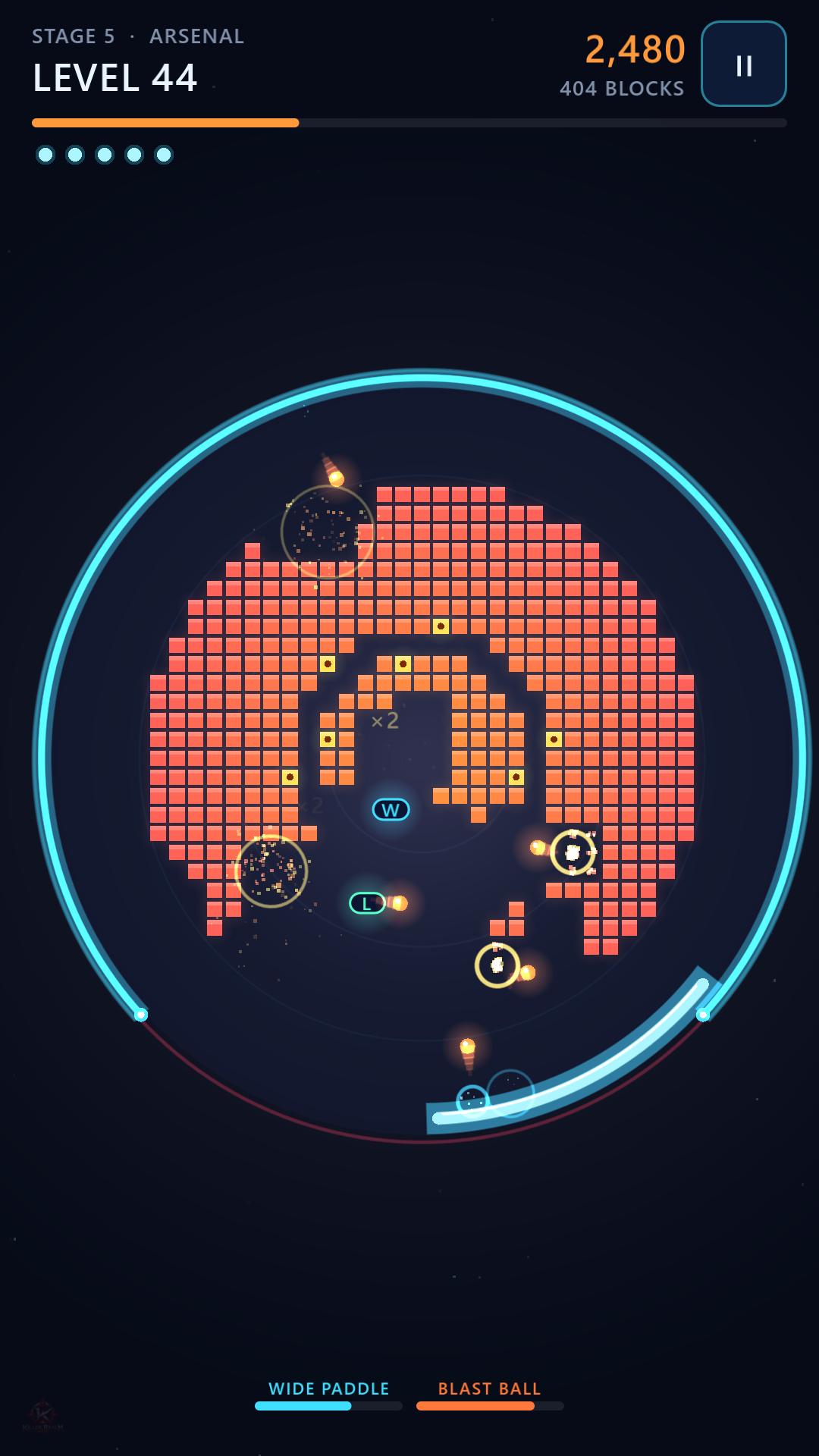
A brick-breaker can look active while giving the player very little to do. In a circular arena, a perfectly ordinary reflection can send the ball around the outer area repeatedly without bringing it back through the remaining blocks. The ball has not stopped. Collision detection has not necessarily failed. Its path is simply unproductive.
Orbit Breaker’s custom simulation has a solid circular boundary interrupted by an exit gap. The paddle defends that gap, while most of the targets sit farther inward. That arrangement gives the game its identity, but it also makes the distance a path passes from the centre important. A ball repeatedly skimming the wall can miss the useful part of the playfield.
Why a circle makes the problem persistent
With an ideal circular boundary, the relationship between the incoming path and the tangent at a bounce can repeat. Rather than exploring every part of the arena, the ball can trace a recurring pattern. If its closest approach to the centre stays outside the remaining block field, another technically correct reflection may produce another miss.
Simply increasing ball speed does not fix that geometry. It can make the same empty journey happen faster while making the player’s eventual save harder. Randomizing every collision would break the pattern, but would also make normal aiming less meaningful. Our 1.1.0 change instead concentrates the correction at the wall, where the problem is observed.
Rule one: avoid a grazing departure
After a wall reflection, the simulation first ensures that the ball leaves sufficiently inward rather than almost parallel to the boundary. The implementation uses a sixteen-degree minimum inward angle. This reduces edge-skimming paths without replacing the entire collision model.
This rule is a floor, not a script for every shot. A trajectory already pointing usefully into the arena does not need the same correction as an almost tangential one. Keeping that distinction helps preserve the relationship between the player’s launch, paddle hit and the next segment of movement.
Rule two: check whether the chord reaches the remaining blocks
The simulation calculates how close the ball’s projected line passes to the centre and compares that with the outer reach of the remaining block field. If the line would sail around that band, it bends the outgoing path inward to a varied depth. Because the block field changes as targets disappear, the test uses what remains rather than a fixed assumption about the opening layout.
This is the useful geometric question: not “did the ball bounce?” but “will this path enter the area where progress is possible?” It lets the game keep its circular wall while giving sparse late-level targets a better chance to be reached.
Rule three: break repeated dry sequences
The simulation also counts repeated wall bounces and bounces without a block hit. After three consecutive wall bounces without a block or paddle touch, or seven wall/paddle bounces without a block, it attempts a directed kick toward a remaining brick. It selects a target, includes a small spread and checks that the outgoing direction is valid. Shielded targets are avoided in the ordinary selection while other blocks remain.
A magenta cue communicates the corrective kick. The player should be able to recognise that the wall has applied a game rule rather than wonder whether the controls changed. This is intentionally an arcade adjustment to the trajectory; it is not a claim of perfectly physical reflection.
What our recorded checks show
The release record compares a 300-run bot sample before and after the rework. In that sample, the longest consecutive wall streak fell from ten to three, and streaks of five or more fell from 213 to zero. The recorded mean longest dry spell fell from 7.1 seconds to 3.8 seconds. These are development simulation results from that sample, not a guarantee about every human session or device.
The same release record says all one hundred levels passed the level-validation pipeline and save checks. The LevelForge tool compiles against the gameplay core used by the game, so the validation is more relevant than a separate imitation of the rules. Nevertheless, a bot clear does not prove every player will win, and a faster route can make time-based star targets easier even when their thresholds are unchanged.
What stayed separate
The fix concerns ball flow, not a change to what the exit gap means. The player still needs to cover that gap. It also does not merge attempt hearts with in-level ball lives or promise a specific power-up drop. Those systems have their own rules, explained in our Orbit Breaker guide.
For this story we inspected the implementation and its recorded release measurements. We did not rerun the 300-run comparison or call the archived screenshot a current-build benchmark. The lesson is narrower and more useful: when motion stops producing progress, measure the repeated pattern before treating speed as the cure.